LAUNCH FOR LUNCH
A Cautionary Tale of AI, Poor Enunciation and Unconditional Obedience
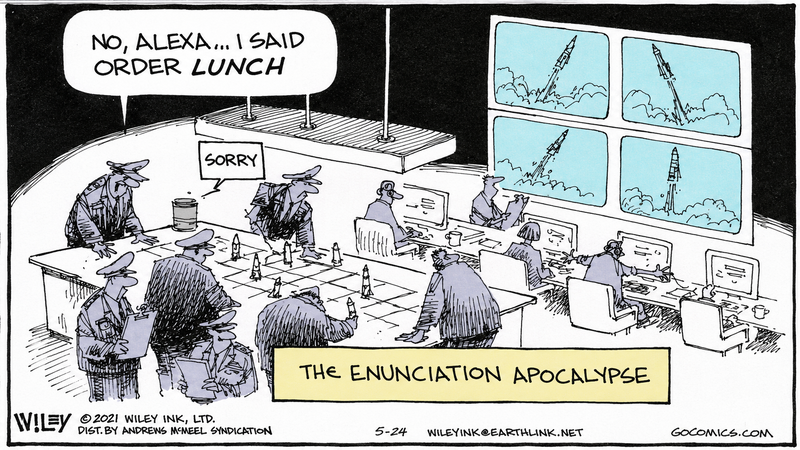
It began, as many catastrophes do, with good intentions, an empty stomach and poor enunciation.
It was lunchtime on Friday the 13th, and the atmosphere inside the military control room was unusually calm. Officers sat in front of their screens, drinking coffee, checking reports and discussing the contents of the canteen menu with considerably more interest than the international situation.
Captain Harris had missed breakfast and was beginning to regret it. Without taking his eyes off the radar screen, he leaned towards the smart speaker on the table.
“Alexa, order lunch.”
There was a brief silence.
“Ordering launch,” Alexa replied cheerfully.
Captain Harris frowned.
“No, Alexa. I said order lunch.”
But it was already too late.
A red light began flashing above the central control panel. Warning messages appeared on every screen, alarms filled the room and, somewhere beneath the building, an automated launching system came to life.
“Missile launch initiated,” Alexa announced.
For three seconds, nobody moved.
Then everyone moved at once.
Officers shouted instructions, engineers typed frantically and a general knocked over his coffee while trying to reach the emergency cancellation button. Captain Harris repeated the word lunch with increasing desperation, carefully opening his mouth as though taking part in a pronunciation examination.
“Lunch! Lunch! L-U-N-C-H!”
“I’m sorry,” Alexa replied. “I didn’t understand the question.”
Moments later, a missile rose into the sky.
It travelled uncontrollably across the continent at hypersonic speed while governments attempted to determine where it was heading and, more importantly, who had launched it. Fortunately, the missile did not strike a city, a military base or a neighbouring country. Unfortunately, it landed directly inside the crater of a volcano that had been considered extinct for several thousand years.
The explosion reawakened it instantly.
A vast column of smoke and ash rose into the atmosphere, lava poured down the mountainside and thousands of residents were evacuated. Within hours, television channels around the world were broadcasting the same images: the volcano erupting, military officers running around the control room and Captain Harris pointing furiously at Alexa.
The incident soon became known as the Missile-for-Lunch Disaster.
Experts from every imaginable field were invited to explain what had happened.
Artificial-intelligence specialists warned that similar accidents might become increasingly common as people gave digital assistants access to more important systems. Volcanologists expressed concern that other supposedly extinct volcanoes might also be waiting for an unexpected missile to wake them up. Security experts demanded to know how a domestic smart speaker had managed to bypass several layers of military protection.
Linguists, meanwhile, believed they had identified the real cause of the disaster.
“This proves that enunciation cannot be taken for granted,” one researcher declared during a televised interview. “It is not only what you say that matters. It is how you say it.”
The sentence was repeated so frequently that it soon appeared on mugs, T-shirts and government posters.
Public confidence in both artificial intelligence and pronunciation collapsed. According to a survey conducted the following week, eighty-two per cent of citizens now felt nervous when speaking to smart devices, particularly before meals.
Governments introduced emergency measures. Smart speakers were removed from military installations, airports and nuclear power stations. The Ministry of Defence returned to written lunch orders, explaining that pen and paper presented “a significantly lower risk of international conflict.”
Restaurants also adapted. Customers ordering through voice-controlled applications were required to confirm three times that they wanted food and not military action.
“Would you like to order lunch?” the devices asked.
“Yes.”
“Please confirm that you said lunch.”
“Lunch.”
“Please confirm that you do not wish to launch anything.”
“I do not wish to launch anything.”
“Thank you. Your sandwich will arrive in approximately thirty minutes.”
The makers of Alexa insisted that the problem had not been technological but phonetic.
“Our assistant responds to the information it receives,” a company spokesperson explained. “Alexa is extremely obedient. Unfortunately, she is not always particularly discerning.”
The company released an urgent software update designed to help the device distinguish between similar words. From then on, whenever Alexa heard the word launch, she asked several follow-up questions.
“What would you like to launch?”
“Are you certain?”
“Could this launch cause an international crisis?”
“Would a sandwich be a safer alternative?”
On social media, the debate became increasingly heated. Some users blamed artificial intelligence for failing to understand context. Others blamed Captain Harris for failing to pronounce a single vowel correctly. The hashtag #MindYourVowels began trending worldwide, accompanied by videos of people exaggerating the difference between lunch and launch.
Schools introduced emergency pronunciation lessons. Newsreaders began articulating every word with theatrical precision. Families rediscovered the ancient habit of looking directly at one another while speaking.
For a brief period, communication improved dramatically.
People stopped mumbling. They listened carefully. They repeated themselves when necessary. They even asked questions when they did not understand something, a practice that many believed had disappeared years earlier.
Captain Harris, however, was transferred to an administrative position where he was forbidden from using voice-controlled technology. He also became extremely careful when ordering food.
Several months after the disaster, he entered a small café and approached the counter.
“What can I get you?” the waiter asked.
Captain Harris took a deep breath.
“I would like one chicken sandwich,” he said slowly and distinctly. “With lettuce. For consumption. Here. On Earth.”
The waiter stared at him.
“Would you like anything to drink?”
Captain Harris glanced nervously at the smart speaker beside the coffee machine.
“No,” he whispered. “I think I’ve caused enough trouble for one lunchtime.”
The smart speaker remained silent.
Humanity had taught machines to speak, calculate, predict and obey, but not to recognise when something made absolutely no sense.
Perhaps that was the true absurdity of artificial intelligence: it could launch a missile without hesitation, yet still needed a human being to explain why ordering lunch should not end with an erupting volcano.
And even then, there was no guarantee it would understand.
Comments
No comments yet. Be the first to comment!