BRAIN DRAIN
Thinking is an accessory
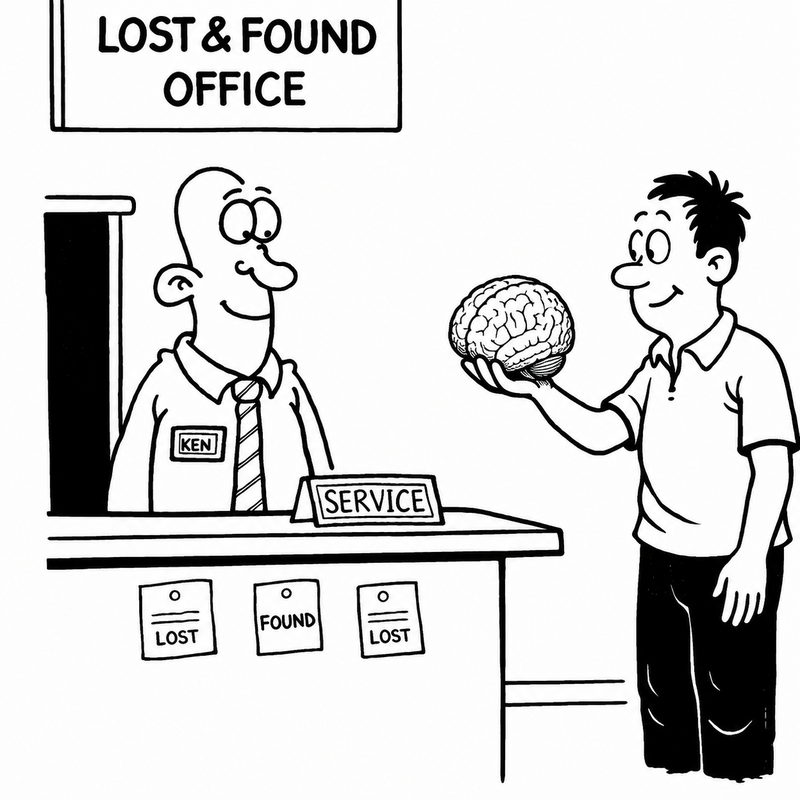
On the evening of the blackout, the city didn’t panic. It hesitated.
At first, people assumed the problem was local. A dead battery. A faulty socket. A router sulking in a corner. They tapped screens, shook cables, unplugged things with the quiet confidence of people who believe the world can always be restarted.
But the lights did not return. The screens stayed dark. And gradually, something unfamiliar spread through the streets: silence without notifications.
I walked home by memory that night, which turned out to be slower than GPS but strangely more reliable. People moved cautiously, as if the absence of blue light had reduced their sense of direction. At one crossing, a man stood staring at a traffic light that no longer worked, waiting for it to tell him what to do.
The next morning, the Municipal Lost & Found received an unusual delivery: three sealed boxes marked:
HUMAN BRAIN — TEMPORARILY DEPOSITED
CONDITION: INTACT
CLAIM STATUS: PENDING RECOVERY
Marta wasn’t surprised.
“Every few years,” she said, stamping a form. “People outsource too much.”
By midday, we had nine.
Some were neatly packed, labelled in careful handwriting. Others arrived in shopping bags, still warm, as if recently removed. One came with a sticky note that read: Back soon, probably.
We created a new category in the register:
COGNITIVE EQUIPMENT
The first person to reclaim a brain arrived just before closing. A middle-aged man, polite, slightly embarrassed, holding a folded city map.
“I believe you may have something of mine,” he said.
We brought out Box 12.
He opened it slowly, with the tenderness of someone greeting an old acquaintance.
“I’d forgotten how heavy it was,” he said, weighing it in his hands.
“Why leave it in the first place?” I asked.
He shrugged.
“Efficiency.”
Silence.
“Efficiency?”
“Most things think for you now. Directions, choices, recommendations. Even opinions arrive pre-packaged.”
He tapped the box affectionately.
“It started feeling redundant.”
“And yesterday?”
“The blackout.”
I nodded.
“The blackout.”
“I spent twenty minutes trying to remember my own address.”
He tapped the map.
"Then I remembered I still owned this."
He paused.
“Then another fifteen trying to remember my wife’s phone number.”
I stared.
“You forgot your wife’s phone number?”
He looked mildly offended.
“No.”
A pause.
“I remembered eventually.”
Another pause.
“I think.”
He examined the brain again.
“Truth be told, I only really used it for taxes and difficult passwords.”
“How long had it been here?”
He considered the question carefully.
“Six years.”
I nearly dropped the retrieval form.
“Six years?”
“Five and a half, perhaps.”
He shrugged.
“Time flies when somebody else is thinking for you.”
For a moment neither of us spoke.
Then he lowered his voice.
“The strange thing is…”
“What?”
“I used to think it made life simpler.”
“And now?”
He looked at the box.
“I’m not entirely sure.”
He signed the paperwork, tucked the brain under his arm and headed for the door.
Halfway across the room he stopped.
“Oh.”
He returned to the counter.
“One more thing.”
“Yes?”
“Do you happen to know whether these require charging?”
I opened my mouth, closed it again, and admitted that I had no idea.
He nodded thoughtfully.
Then he helped himself to an old charger from a box labelled JUST IN CASE and left.
Over the next two days, more people came.
A student who only needed her brain during exam season.
A man who preferred not to overthink.
A woman who hoped her habit of reflection was still in working condition.
One visitor returned his brain after twenty minutes.
"Too noisy," he said. "I'd forgotten about the thoughts.
When electricity was finally restored, the stream of visitors slowed. Some brains remained on the shelves, patiently waiting, their labels curling slightly at the edges.
Marta updated their status:
PENDING RECOVERY
A week later, the office was quiet again. The city had resumed its habits. Screens glowed. Voices returned to their usual distracted pitch. Navigation resumed. Recommendations resumed.
Thinking, for the most part, did not.
That afternoon, I noticed a box I had somehow never opened.
The label read:
HUMAN BRAIN — UNCLAIMED
CONDITION: PRISTINE
I stared at it for a while, wondering what kind of life leaves so little trace of use.
Later, as I was closing the office, I noticed something tucked beneath the counter.
It was the folded city map the man from Box 12 had forgotten.
I unfolded it carefully.
The paper was creased and worn, the edges softened by years of use. Entire streets had been traced over in pen. Tiny handwritten notes filled the margins. Somebody had relied on it once.
Outside, the streetlights flickered on, one by one, like a city remembering itself.
I looked from the map to the shelf where the pristine brain still waited to be claimed.
It occurred to me then that, like old maps, people don't really lose their brains at all. They simply stop carrying them when something more convenient comes along.
Until one day, the signal disappears, the battery dies, or the world goes dark.
And suddenly, they need a way home.
Comments
No comments yet. Be the first to comment!